
Dear Disinfo Update readers,
Thank you for being with us again this week.
In Europe, Member States are stepping up the pressure on platforms. In Spain, TikTok is under mounting scrutiny over child safety: following a Maldita.es investigation, public prosecutors have taken the platform to court, and EU regulators have also been alerted. In Italy, the data protection authority fined Meta €805 million for accessing Android users’ photos and videos without specific consent. The lesson is simple: when existing rules are applied, investigations open and sanctions follow.
Brazil offers a striking parallel. During the presidential election runoff, the Superior Electoral Court ordered Meta not to unjustifiably limit the reach of candidates’ content and ruled the algorithmic recommendation of candidates illegal. Meta’s response attributed the disputed incidents to technical failures rather than political bias. It is striking that, under such pressure in Brazil, Meta communicated publicly to an extent we have rarely seen in Europe. Whatever the explanation, the episode shows how urgently we need deeper research, debate and regulation of (or enforcement of existing regulation, where such exists) the role platforms play in how people access information.
On our side, the webinar programme for the year will wrap up in December with an exciting new session with OCCRP on how research on corruption schemes and disinformation campaigns overlap. Log in to DisinfoHub to get access to these webinars and lots more. (And if you don’t have an account yet, register here.) We will be having our first community meetup in Madrid on 24 November, where our Spain-based team will be on hand for an informal chat with the local community fighting disinformation.
We hope to see you there,
The EU DisinfoLab team

MEMBER STATES IN ACTION: SPOTLIGHT ON SPAIN
TikTok faces mounting pressure in Spain, from prosecutors to advertisers, over child sexual abuse material on its platform, as the case moves to the courts and EU regulators.
- Content warning: A Maldita.es investigation finds that TikTok’s search engine, recommendation algorithms and gifting features steer users to child sexual abuse material and monetise harassment of minors (Maldita.es)
- After Maldita.es filed a criminal complaint against TikTok, Spain’s Attorney General’s Office took the platform to court over the child sexual abuse videos detected in the investigation (Maldita.es)
- Spain’s government calls for a temporary suspension of TikTok in the country (Reuters). Can Spain ban TikTok? The Spanish Prime Minister’s threat runs up against EU rules (Politico)
- Spain’s data protection authority closes its preliminary TikTok probe to avoid interfering with the criminal case and passes the available information to Ireland’s data protection regulator, the EDPB and the European Commission (AEPD)
- TikTok loses major advertisers in Spain, including El Corte Inglés, Banco Santander, Moeve and Eroski (El País)
A Spanish court rules against an MEP who turned an unverified police alert into a public accusation.
- Spanish MEP Alvise Pérez must pay €20,000 for sharing on Telegram the identity and photo of a man he linked, without evidence, to carrying explosives, presenting an unverified police alert as fact (Demócrata)
Beyond Spain, other national regulators are also stepping in.
- Italy fines Meta €805m over accessing users’ photos (BBC)
platformS UNDER SCRUTINY
The Commission targets the design of TikTok’s recommender system, not just the content it hosts.
- Commission preliminarily finds TikTok’s ‘For You’ feed in breach of the Digital Services Act for pushing users into ‘rabbit holes’ of harmful content on mental health and body image (European Commission)
- TikTok’s own risk assessment reveals little about how its recommender system pushes users into harmful sequences of content, raising concerns about merely “symbolic” compliance with the DSA, an analysis argues (Tech Policy Press)
Elections put platforms and political influencers to the test.
- Brazil: Top electoral court fines Meta $1.3 million over failing to fully comply with judicial orders (DW)
- Meta argues the incidents affecting campaigns were technical issues and errors, not political bias (Meta)
- Research finds that most election laws weren’t designed for political influencers and rely on traceable payments, allowing much coordinated promotion to escape the rules (International IDEA)
Platforms’ approaches to fact-checking and content moderation are increasingly questioned.
- An analysis of Meta’s Community Notes in the month before the 2026 US midterms found a quarter were about politics, some debunking politicians’ claims, though many offered opinion or unnecessary context rather than fact checks (Indicator)
- A network of 47 fact-checking organisations from 20 countries calls on platforms, governments and funders to protect reliable information in Latin America, expressing concern about Meta’s plan to replace fact-checking with Community Notes in the region (LatamChequea)
- French users, activists and independent media accuse platforms of hiding or removing protest content under political pressure. The claims are hard to prove, the newspaper notes, but the suspicion is driven by platform opacity and the government’s heavy focus on social media (Le Monde)
Tech giant pushes back against national surveillance rules.
- Meta claims that it would consider pulling encrypted services from Canada if the government’s proposed lawful access bill passes without further changes (CBC News)
FOREIGN INTERFERENCE AND HYBRID THREATS
Leaked files expose the inner workings of Russian influence operations, while the EU sanctions the Kremlin-backed firm linked to Doppelganger.
- John Mark Dougan, a former US sheriff’s deputy who fled to Russia, spread disinformation at the request of Russia’s GRU and FSB intelligence services but has since become sidelined and broke, according to his hacked messages (The Insider)
- Hundreds of politicians, former officials and academics from more than 50 countries were interviewed for sites that were part of Russia’s Doppelganger campaign, a leaked database shows (OCCRP)
- The EU sanctions the Kremlin-backed Social Design Agency and 24 of its staff over information manipulation campaigns targeting EU countries, alongside pro-Russian propagandists and the hacker group NoName057(16) (Council of the EU)
Russian influence operations intensify across Europe, with Spain’s 29 November elections in the crosshairs.
- Russian operation “Matryoshka” (Operation Overload) launches campaign to interfere in Spain’s 29 November vote, impersonating media outlets to exploit Catalan separatism and the housing crisis (Maldita.es)
- Much of the election disinformation spread by Russia’s Pravda network in Spain originates in Spanish far-right Telegram channels, an analysis finds (Newtral)
- A Madrid university hosts a conference co-organised by the Russian state agency Rossotrudnichestvo’s cultural centre despite the international academic boycott, prompting 21 experts to warn that academic freedom cannot become “an alibi for whitewashing the violence and policies of an occupying state” (El País)
- Elsewhere, the Operation Overload/Matryoshka network exploited French riots on social media, an EU report finds (Reuters), and has now expanded this activity to Tumblr (Hervé Letoqueux / LinkedIn)
AI Disinfo Watch
In this edition, we highlight the new risks AI poses to information integrity, including challenges for emergency services and live communication. We also look at new cases and techniques of AI “grooming” for FIMI purposes, illustrated by pro-Russian propagandist John Mark Dougan and a campaign against Naza, the award-winning documentary on Gaza. Meanwhile, new investigations shed light on how AI companies try to monitor dangerous behaviour, often too late, while regulators press for more information to improve safety. Finally, the EU’s top court is examining its first generative AI copyright case.
AI broadens the risks: emergency services, live communications and more.
- Microsoft patents an AI that can literally put words in people’s mouths in real time (Futurism)
- AI is making it harder to detect fake emergency calls (NPR)
- Reading the darkest chats, too late (Pulitzer Center)
Grooming the chatbots for FIMI.
- Dougan leak exposes concerted effort to infect AI (NewsGuard)
- Chatbots are being manipulated to promote a counter-documentary targeting the Gaza film Naza (Mediapart)
Regulators and courts in action.
- EU presses OpenAI, Anthropic for more details on AI safety incidents (Rapporteur)
- Google chatbot ‘may be infringing press rights’ (The Law Society)
COP31 AND CLIMATE DISINFORMATION
Governments, researchers and campaigners push for reliable climate information, from the negotiating rooms in Antalya to AI chatbots and fossil fuel ads.
- The first draft of the COP31 cover decision includes “information integrity” in paragraph 45, recognising it alongside science as essential to climate action and calling for protection of frontline defenders. (UNFCCC / CAAD)
- A UNESCO and University College London study presented at COP31 finds that AI chatbots are “sycophantic by design”, abandoning established climate facts in eight out of ten cases when mildly challenged by users, scoring just 33.8% on how climate policies interact (UNESCO / The Guardian)
- In the run-up to the summit, oil and gas companies increased their new Google ads by 125.6% globally in October and by 996% in the host country, Türkiye, in September (CAAD)
- Ahead of COP31, a Forum on Information and Democracy report finds most countries lack a strategy against climate disinformation, and that the protection of environmental journalists is largely missing from national policies (RSF)
BRUSSELS CORNER
Commission presents Digital Fairness Act
The Commission presented its proposal for the Digital Fairness Act (DFA) on 11 November, alongside a revision of the Consumer Protection Cooperation Regulation. The DFA would, among other measures, ban dark patterns, allow addictive features to be turned off, introduce “fairness by design”, and restrict personalised ads targeting minors or using sensitive data. How the DFA will fit with existing rules such as the Digital Services Act (DSA), given both their overlap and the DSA’s under-enforcement, is still an open question. (European Commission)
Dutch MP proposes ban on addictive design features
On 2 November, before the Digital Fairness Act was proposed, Dutch MP Barbara Kathmann (PRO) tabled a proposal to ban addictive design features for all online services, such as infinite scrolling, autoplay, push notifications and manipulative algorithms. The proposal would also implement “fairness by design” for platforms, requiring them to prove they are “fair and non-manipulative”. (Euronews)
Commission opens two consultations on the DSA
Two new DSA consultations have been opened in November. The first is a call for evidence, open from 4 November until 2 December, for the technical guidelines on advertising repositories planned for 2028. These are repositories that the very large platforms and search engines must make publicly available, as well as easily accessible and searchable. (European Commission)
The second is a targeted consultation on the draft revised election guidelines, which these platforms should adopt to tackle risks to elections from generative AI and information manipulation. Stakeholders have been given an unusually short window to respond: just 13 days, from 10 to 23 November. (European Commission)
Explore the full Brussels Corner on our website.

🧡 One thing we loved
Ahead of Spain’s 29 November general elections, Comprobado 29N brings together all seven Spanish fact-checking organisations and around twenty media outlets to identify hoaxes and misleading narratives about the electoral process. Comprobado speaks directly to voters, publishing fact-checks on the Comprobado website for anyone to consult and share.
First launched in 2019 and revived for the 2023 general elections, the initiative is a good reminder that collaboration remains one of the community’s strongest tools against electoral disinformation.
📚 Recommended pick
This week’s recommended read, selected by our Project Manager Inès Gentil, looks at how extremist groups are using AI to generate propaganda, glorify attackers and circumvent content moderation. Published by the Christchurch Call Foundation, the “Artificial Intelligence, Violent Extremism, and Nihilistic Violence” report compares four groups: Salafi-jihadists, the violent extreme right, incels and violent misogynists, as well as nihilistic networks.
The takeaway: there is no single “extremist AI playbook”; Jihadist networks favour symbolic imagery that avoids moderation, the extreme right and nihilistic communities favour memes glorifying attackers. Even the choice of tools differs: groups pick models that fit their goals, from jihadist networks prioritising security and avoiding paid subscriptions to extreme-right users using AI models with less oversight.
On the regulatory side, the message is that if the threat is this varied, one-size-fits-all safety testing will miss it, and so will enforcement built on that testing. The authors call for granular, expert-informed evaluations, government-funded independent testing, and incentives for developers to publish their results on these tests – for example through model cards or transparency reports. They also urge platforms to prevent the algorithmic amplification of terrorist content and of related harmful content that falls short of the terrorist-content threshold, the ‘grey zone’ that systemic-risk frameworks like the EU’s Digital Services Act are meant to reach. Whether that is enough is a fair question to ask: the report conclusions mainly rely on incentives and voluntary reporting, so it is worth asking what it would take to make such evaluations enforceable, and what a clear benchmark for an “adequate” AI-related risk assessment would look like.
🔎 Our latest work
Blogpost: Europe’s missing watchdogs
In our latest blogpost, we look at a shared problem for the enforcement of the DSA and the AI Act: the many Member States that were late in empowering or setting up the national authorities to oversee them. Thirteen countries missed the DSA deadline, and only eight met the AI Act one. Without these bodies, individuals have no national authority to turn to, countries lose a voice at the EU level, and the rules risk existing only on paper. Read it here.
For further background on how EU DisinfoLab covers DSA enforcement challenges, you can watch DSA: Unfolding the European Commission’s first decision against X, a discussion moderated by the blog post’s co-author Joe McNamee.
Register for DisinfoHub. The single place to access community-only content, webinars, conference materials, publications and updates, with new resources added regularly. Sign-in is passwordless: just register, get approved, and you’ll receive a secure login link by email. Create your DisinfoHub account!
Call for venues #Disinfo2028. With #Disinfo2027 already in the works, we’re now scouting host cities for our 2028 annual conference. If your organisation or city would like to be considered, get in touch by replying to this email.
👀 Spotted
Inès Gentil spoke at the JPEG Trust Summit at the Alan Turing Institute in London on 12 November, making the case that to tackle (AI-generated) disinformation, we should look at the infrastructure that carries it and not just the content, drawing on lessons from Romania’s annulled 2024 presidential election and the Southport riots. Her key policy ask: a concrete, auditable definition of what an “adequate” platform risk assessment looks like under the Digital Services Act, so that enforcement can keep pace with harms that spread within hours.
Spot our Executive Director Alexandre Alaphilippe at the 12 November GLOBSEC event in Brussels, focusing on building democratic resilience and whole-of-society approaches.
Also check out Alexandre being recognised in Civitates’ article, “Attacks on the Freedom of Assembly: Lessons from Digital Rights Defenders”, for his courage under pressure throughout #Disinfo2026 in Vilnius, Lithuania this October.
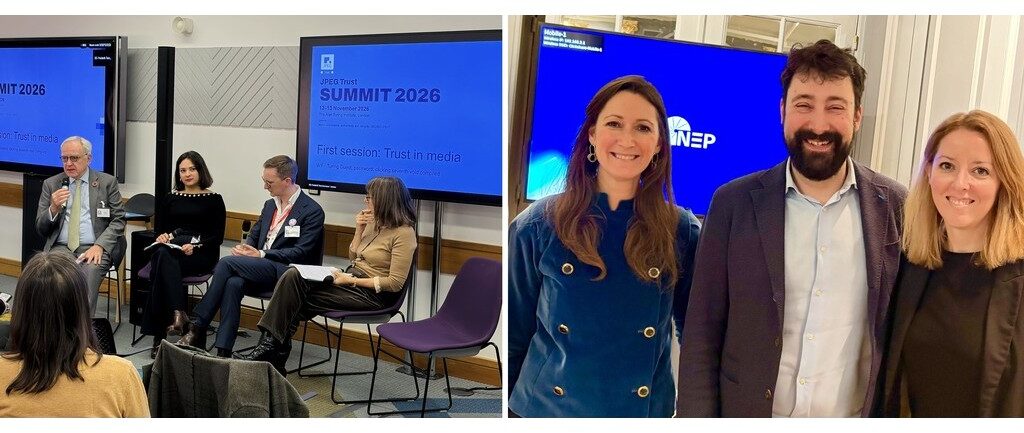
🤝 Community meetup
Thank you to those who joined us last night at our Brussels community meetup! Catch future meetup announcements and details on DisinfoHub.
Tuesday, 24 November, 19:00-21:00. Madrid community meetup. Details on DisinfoHub.
💬 EU DisinfoLab webinars
- 19 November. Tracking the fake activity market
- 26 November. From the Margins to Elections: Repro Uncensored’s Global Fight Against Digital Censorship
- 17 December. Following the Money: How to Investigate Beyond the Digital Trail
Register via DisinfoHub, where our webinars and community content now live. New accounts are reviewed by our team, so sign up early to be approved in time.
Recordings are available exclusively on DisinfoHub. For webinars held on or before 17 September, see here.
🧰 Tools & Learning
- Capacity-building on climate law & disinformation. Agence France-Presse (AFP) has launched the Future of the Planet Legal Desk, a specialist editorial unit covering environmental litigation, corporate accountability, and climate disinformation, while offering training and capacity-building for journalists inside and outside the agency to report on complex environmental law.
- 27 tips for investigating mobile apps. A practical guide by Indicator on how to uncover who is behind an app, what its app store listing and user reviews reveal, and whether it behaves differently when installed via an advertisement.
🗓️ Events on our radar
- 20 November. Unlocking Data: Exploring research opportunities on online platforms, by the Netherlands Authority for Consumers & Markets (online)
- 25 November. ECAT Research Workshop 2026, by the European Commission (Seville, in-person)
- 25 November. An Abdication of Responsibility: Why Advertising Firms Continue to Monetise Hate, by Purpose Disruptors (online)
- 26-28 November. Voices – European Festival of Journalism and Media Freedom, by the Centre for Media Pluralism and Media Freedom (Thessaloniki, in-person)
- 26-29 November. Security and Civil Society Conference 2026, by Sillamäe Lastekaitse Ühing (Narva, in-person)
- 30 November. DISRUPT for Enforcing EU Laws, by Alliance4Europe (online)
- 3 December. Election interference and FIMI – Lessons from Eastern Europe, by The Hague Centre for Strategic Studies (The Hague, in-person)
- 4-6 December. ARIJ 19th Annual Forum: Stories with Impact, by Arab Reporters for Investigative Journalism (Amman, Jordan; in-person)
- 10 December. EMIF Closing Event, by the European Media & Information Fund (Florence, in-person)
- 10 December. FACTEUR Training Programme: Digital Safety and Rapid Response Protocols, by the European Fact-Checking Standards Network (online)
- 23–25 March 2027. Cambridge Disinformation Summit 2027 (Cambridge, in-person)
- GlobalFact 2027 (Dates to be announced) (Antwerp, in-person)
🤝 Jobs & opportunities
- NewsGuard. Staff Reporter
- CDT. Academic Year Externship
- VIGINUM. OSINT Analyst – Continental Europe
- University of Southern Denmark (SDU). PhD position(s) on conspiracy theories in political communication at the Digital Democracy Centre
- interface. Policy Researcher, Digital Public Sphere Programme
- NewsGuard. Staff Reporter, French team
- King’s College London. Research and Innovation Associate in Digital Media and Online Misinformation
- Center for Countering Digital Harm (CCDH). Multiple positions
- The Alexander von Humboldt Institute for Internet and Society (HIIG). Impact AI Fellowship 2027
- Recorded Future. Threat Intelligence Analyst
- Europol. Call for members – EC3 Advisory Group on Research and Development
- European Fact-Checking Standards Network (EFCSN). Tech Partnerships Lead
Have something to share – an event, job opening, publication? Send your suggestions via the “get in touch” form below, and we’ll consider them for the next edition of Disinfo Update.