
Dear Disinfo Update readers,
We’re happy to reach out to you again this week. The past two weeks have been very busy, with a strong focus on the role of social media platforms in elections: the unequal service accessibility of presidential candidates on WhatsApp in Brazil, accusations of foreign interference in Israel, and one could expect more disinformation and conspiracies coming up in the midterm elections this week.
On this note, it is worth highlighting a growing trend of “technical incidents” being used by tech companies to justify distortions in access to information. In Brazil, multiple technical incidents prevented several campaigns and political candidates from communicating properly with their followers and subscribers on Meta products. The same happened in the United States with the “No Kings: Vote Early” demonstrations, where automated systems prevented accounts organising the protests from reaching their audiences. A similar argument also came up in discussions of attacks on AI agents, such as in the Hugging Face incident.
These “technical incidents” increasingly serve as an excuse to evade accountability for the platforms’ product design and safety issues. They should not be treated as isolated cases, but as symptoms of a broader issue: how these tech products create systemic risks for our democratic processes and for access to pluralistic information.
We will continue working on these issues with the community in the coming months, a community that now has access to more resources through our DisinfoHub, including our upcoming webinars and community drinks – the next two are taking place in Brussels on 17 November and in Madrid on 24 November. We will also be back soon with a special community event in early December, so keep an eye on the DisinfoHub 😉 As a reminder, a selection of photos and presentations from #Disinfo2026 is available for the community at the DisinfoHub. If you haven’t created your account yet, now is the time to do so here.
Talk to you very soon!
Sincerely,
The EU DisinfoLab team

REGULATORY ENFORCEMENT
Meta faces a record penalty in the US, while in Romania political ads slip through despite the company’s own self-ban in the EU.
- A New Mexico judge ordered Meta to pay $25 billion after a jury found it misled users about their data, in a case tied to the Cambridge Analytica scandal. Meta plans to appeal. (CNN)
- Despite Meta’s self-ban in the EU, Funky Citizens found 437 ads with political content on Romanian Facebook pages, only 21 of them labelled as political. (BROD / Funky Citizens)
Online scams on platforms come under the Commission’s scrutiny.
- Booking.com targeted in EU investigation into phishing scams and fraudulent listings (Reuters)
- A Commission-procured DSA study finds that scammers exploit the very ad systems, algorithms and monetisation models platforms are built on (European Commission)
The Digital Omnibus moves forward in the Council of the EU, amid scrutiny of Big Tech’s influence on the file.
- Big Tech lobbied EU governments to weaken data protection in the Digital Omnibus (Corporate Europe Observatory)
- The Council agrees position to simplify data protection, privacy and cyber reporting rules (Council of the EU)
platformS AND ELECTIONS
In Brazil and the US, Meta restricted the accounts of candidates and campaigns in the final weeks before the vote.
- Internal messages from Meta employees acknowledged that Lula’s accounts were hindered by restrictions during Brazil’s election. Meta denies favouring either side (Reuters)
- Meta suspends Florida Senate candidate Angie Nixon’s Latino outreach Instagram page during a get-out-the-vote rally (TheGrio via Yahoo News)
In the run-up to the 3 November US midterm elections, false claims and undisclosed paid political content spread with few checks.
- X’s Community Notes missed 93% of posts pushing false midterm claims, including four claims spread by Elon Musk himself (NewsGuard)
- 35% of TikTok influencers agree to boost midterm candidates, with no disclosure of payments, in NewsGuard sting (NewsGuard)
Meanwhile, in Europe, the EDMO network is turning election monitoring into practice.
- EDMO draws lessons from six national elections to inform the review of the DSA Election Guidelines (EDMO)
- IBERIFIER activates the European rapid response system ahead of Spain’s general elections on 29 November and publishes a preliminary risk report (IBERIFIER)
Influence operations
Two analyses look at the role of foreign actors in France’s October protests.
- There is no evidence foreign powers sparked the riots, only that they exploited them; the Commission has yet to act, citing insufficient evidence (Euronews)
- “Foreign actors worked actively to amplify and inflame public anger, both before and after the protests, and to applaud violence, with the further aim of polarising the debates and dividing French society”. (Alliance4Europe)
Research examines how Russia’s propaganda is funded and spread, from state budgets to obscure networks and media projects abroad.
- Mapping the Russia-linked influence infrastructure behind the ‘International Burke Institute’, an obscure Israel-based institute (Cyfluence Research Center)
- Russia plans to spend around $2 billion on propaganda in 2027, increasingly funding online projects aimed at younger audiences alongside state media like RT (BBC Monitoring)
- A French media billionaire, Vincent Bolloré, paid tens of thousands of euros to former RT France head Xenia Fedorova to help her launch a news agency to rival AFP (Blast)
- As a ceasefire opens up besieged Oleshky, Russia may coerce starving residents into staged propaganda videos blaming Ukraine, Peter Pomerantsev warns (Kyiv Independent)
Israel: election interference accusations thrown at each other as new arguments in political battles
- Netanyahu warns of possible foreign interference in the Israeli elections and calls for an immediate investigation (Demócrata)
Two investigations expose long-running disinformation campaigns whose sponsors remain hidden.
- Manufacturing the ‘Great Replacement’: researchers trace a covert anti-Muslim, anti-migrant and anti-Qatar ad campaign that has delivered more than half a billion recorded exposures across Europe, Lebanon and the US since 2023 (Marc Owen Jones and Sohan Dsouza)
- Qatargate vs Belgiumgate: a network of fake news websites has spent more than three years trying to discredit the Qatargate investigation, targeting Belgian justice and the media (Le Soir / Knack)
AI Disinfo Watch
Researchers are keeping a close eye on the role of AI-generated content in election campaigns. In Spain, political parties are using deepfakes, some of them controversial enough to trigger legal action, while in the US, concerns extend beyond AI-driven disinformation to how voters get election information from chatbots.
- The Spanish prime minister’s wife files a legal complaint against opposition party PP over election campaign deepfake (Demócrata)
- AI-driven disinformation is running rampant on social media before US midterms, experts warn (The Guardian)
- AI Chatbots perform better on US election-related false claims than other types of myths, but remain vulnerable to malign actors (NewsGuard)
- OpenAI assures its new Model Spec will incorporate a “Do not lie” principle (OpenAI)
AI keeps raising privacy and security concerns:
- Now Google says it might use your Gmail and Google Photos data to target ads (The Verge)
- Friends don’t let friends feed their data to AI agents (The Verge)
- Swedish government blocks ChatGPT and Claude, citing security risks (Cybernews)
The rise of AI agents raises a crucial legal question: who will be held responsible for their actions? Meanwhile, the EU is facing pressure from tech companies over its AI legislation.
- The EU is facing Big Tech pressure to revamp its AI law (Politico)
- Before an AI agent acts, name who’s responsible (The Strategist)
We usually think of AI as a tool that supports human decision-making, but a new study warns of the cognitive influence chatbots can have on people. Meanwhile, experts reflect on AI’s supposed “inevitability” and on how AI, among other factors, is contributing to the “death” of the internet.
- Who’s Aligned to Whom? How AI Agents Shape Experts’ Research Judgment Calls (Anthropic research)
- Is AI Inevitable? (ie.edu)
- Let the Internet die (Wired)
BRUSSELS CORNER
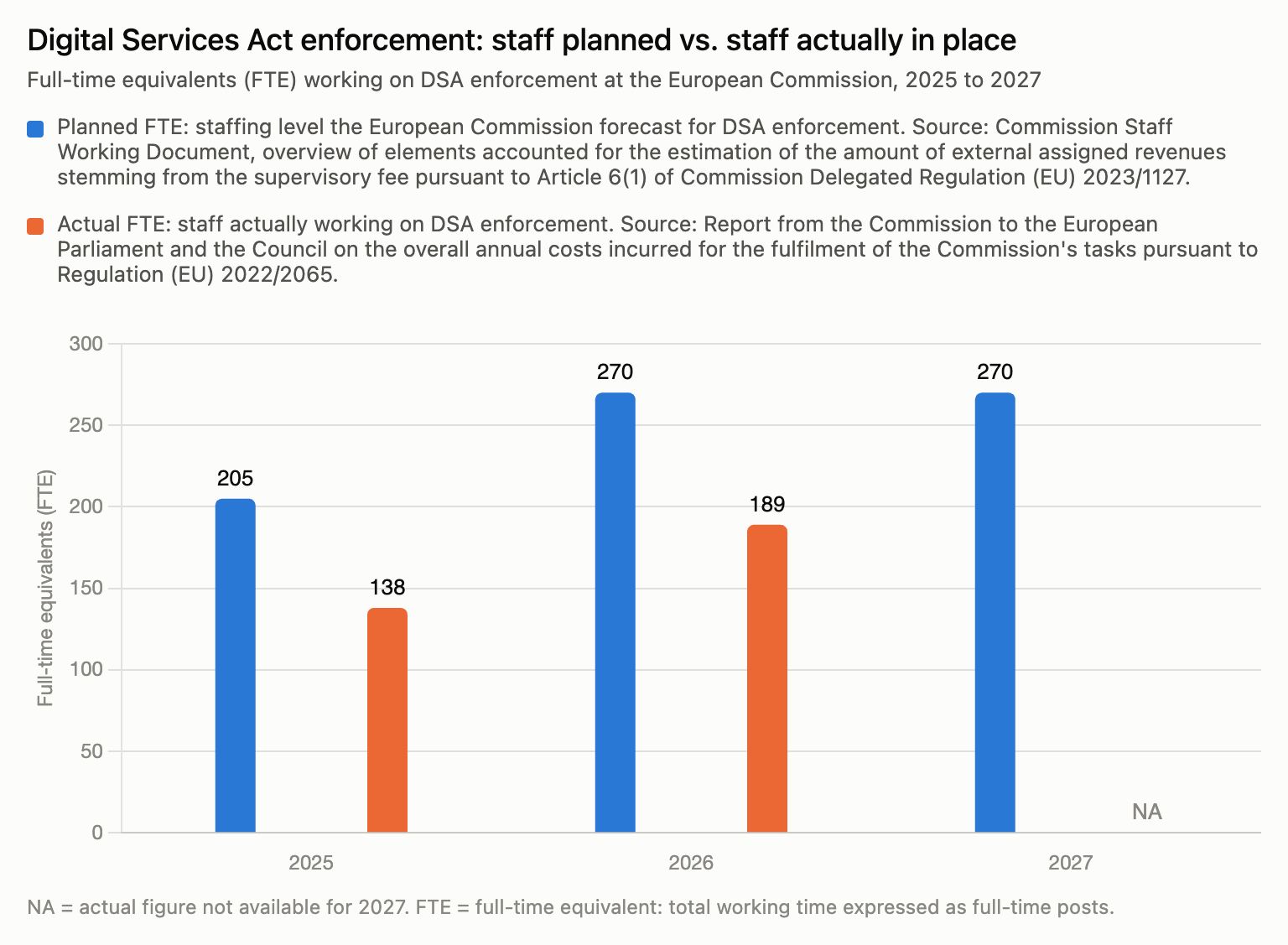
The Commission pushes back DSA enforcement staffing target to 2027
In response to a question from MEP Sandro Gozi (Renew), the Commission confirmed that 189 staff were working on Digital Services Act (DSA) enforcement as of June 2026, while the original target for the year was 270. This goal has now been pushed back to the end of 2027, leaving DSA enforcement understaffed while the Council of the EU and the European Parliament call for stronger enforcement of existing legislation. (European Parliament)
Von der Leyen replies to civil society letter on the Digital Fairness Act
President of the European Commission Ursula von der Leyen has replied to a letter from BEUC, the European Consumer Organisation, with over 200 signatories supporting a strong Digital Fairness Act (DFA). BEUC’s Urs Buscke’s analysis of the reply points out that the DFA will address gaps in current consumer law, such as dark patterns, addictive features and subscription traps, and will not reopen issues already covered by the DSA, DMA and AI Act. He also notes that, even without naming the Kids Act, the protection of minors is mentioned as a key priority. (LinkedIn)
Update on AgoraEU cuts: new budget proposal expected before 26 November
The latest budget proposal for 2028-2034 planned cutting AgoraEU by 30%, from €8.6 billion to €6 billion. However, EU leaders failed to agree on the budget at the summit on 15-16 October, and European Council President António Costa will table a new proposal before a special summit on 26 November. EDMO points out that reversing the cut in this new proposal would only cost 0.14% of the budget, and would contribute towards a healthy information ecosystem in the EU. (EDMO)
Digital civil society asked to do more with less
The proposed cuts to AgoraEU come as digital civil society groups are still being asked to do more. EU officials acknowledge that these groups provide much of the evidence behind digital regulation and act as an early-warning system for threats to democracy. But, despite them playing a central part to Europe’s digital sovereignty ambitions, the EU has still not set aside sufficient support for them in its next budget. (Tech Policy Press)
Code of Conduct on Disinformation holds twelfth plenary
On 27 October, signatories of the Code of Conduct on Disinformation met for the twelfth plenary of its Permanent Task Force. Executive Vice-President Henna Virkkunen and Deputy Director-General of DG CONNECT Renate Nikolay attended, and discussions covered emerging election risks, crisis response actions and demonetisation of disinformation. (European Commission)
Explore the full Brussels Corner on our website.

📚 Recommended pick
This week’s recommended read, selected by our Research Manager Maria Giovanna Sessa, examines the debate around possible Russian interference in Italy’s recent student protests. The demonstrations became increasingly polarised as episodes of disorder involving different groups, including some young people from migrant backgrounds, overshadowed their original focus on the cost of living.
First published by Facta and later by EDMO, “The Conspiracy Theories of Anti-Conspiracy Theorists” explores how even those well versed in disinformation can be drawn to suspicions of external orchestration, despite the absence so far of evidence demonstrating Russian involvement. It also considers how online platforms amplify unrest and how speculation about foreign interference can magnify their perceived influence, further deepening social divisions.
🔎 Our latest work
- #Disinfo2026 content: 📸 Photos from the conference, as well as a selection of slides from presentation sessions are now available to view on the DisinfoHub.
- Register for DisinfoHub. The single place to access community-only content, webinars, conference materials, publications and updates, with new resources added regularly. Sign-in is passwordless: just register, get approved, and you’ll receive a secure login link by email. Create your DisinfoHub account!
- Call for venues #Disinfo2028. With #Disinfo2027 already in the works, we’re now scouting host cities for our 2028 annual conference. If your organisation or city would like to be considered, get in touch by replying to this email.
👀 Spotted
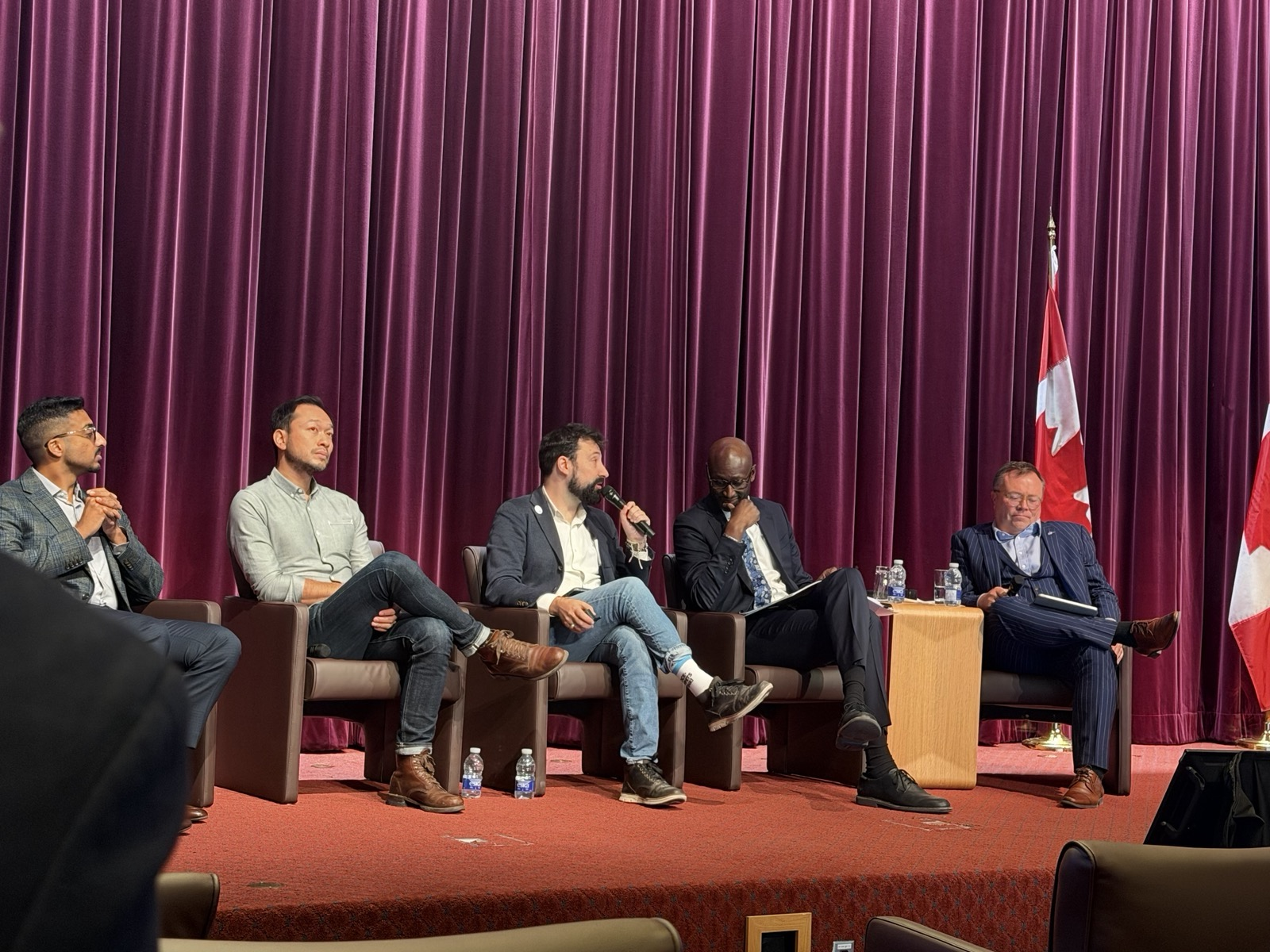
Check out our #Disinfo2026 socks in the spotlight at the G7 Rapid Response Mechanism forum in Ottawa, courtesy of our very own Alexandre Alaphilippe, who broke down the interference that tried to disrupt #Disinfo2026, and what it means for designing meaningful whole-of-society approaches.

🤝 Community meetup
Tuesday, 17 November, 18:00–20:30. Brussels community meetup. Details on DisinfoHub.
Tuesday, 24 November, 19:00–21:00. Madrid community meetup. Details on DisinfoHub.
💬 EU DisinfoLab webinars
- 5 November. The hype around AI and its potential for disinformation
- 19 November. Tracking the fake activity market
Register via DisinfoHub, where our webinars and community content now live.
New accounts are reviewed by our team, so sign up early to be approved in time.
Missed a session? Watch our past webinars.
🧰 Tools & Learning
Indicator. Look for entities associated with digital deception: the new Entity Vault lets search nearly 3,000 accounts, domains, companies, phone numbers, and other entities linked to digital deception. about using AI in your investigations?
🗓️ Events on our radar
- 5 November. Launch of Influence and Political Integrity: Mapping Regulatory Frameworks for Influencers in Elections, by the University of Ottawa Centre for Law, Technology and Society; Pol Comm Tech Lab; International IDEA (online)
- 9 November. Verification, Disordered Discourse, and the Repair of Democratic Reality webinar, by Bellingcat (online)
- 11-12 November. FACTCHECK Final Conference: Knowledge Is Power in the Age of Information Disorder, by FACTCHECK (Porto, in-person)
- 12 November. Webinar: Countering Anti-Trans Misinformation: Tools, Tactics and Lessons from Across Europe, by TGEU and the European Fact-Checking Standards Network (EFCSN) (online)
- 18-19 November. CFI Forum 2026: informing better together, by CFI Media Development (Saint-Ouen, France, in-person)
- 20 November. Unlocking Data: Exploring research opportunities on online platforms, by the Netherlands Authority for Consumers & Markets (ACM) (online)
- 25 November. ECAT Research Workshop 2026, by the European Commission (Seville, in-person)
- 26-28 November. Voices – European Festival of Journalism and Media Freedom, by the Centre for Media Pluralism and Media Freedom (Thessaloniki, in-person)
- 26-29 November. Security and Civil Society Conference 2026, Sillamäe Lastekaitse Ühing (Estonia, in-person)
- 4-6 December. ARIJ 19th Annual Forum: Stories with Impact, by Arab Reporters for Investigative Journalism (Amman, Jordan; in-person)
- 10 December. EMIF Closing Event, by the European Media & Information Fund (Florence, in-person)
- 23-25 March 2027. Cambridge Disinformation Summit 2027 (Cambridge, in-person)
- GlobalFact 2027: (Dates TBC) (Antwerp, in-person)
🤝 Jobs & opportunities
- NewsGuard. Staff Reporter
- CDT. Academic Year Externship
- VIGINUM. OSINT Analyst – Continental Europe
- University of Southern Denmark (SDU). Multiple positions
- interface. Policy Researcher, Digital Public Sphere Programme
- Bellingcat. Contractor: AI Engineer (Open Source Agentic Systems)
- NewsGuard. Staff Reporter, France
- King’s College London. Research and Innovation Associate in Digital Media and Online Misinformation
- Center for Countering Digital Harm (CCDH). Multiple positions
- The Alexander von Humboldt Institute for Internet and Society (HIIG). Impact AI Fellowship 2027
- Faktabaari. Journalist (part-time, parental leave cover, in Finnish)
- Ofcom. Director of Research Innovation and Data
- Funding opportunity: Creative Europe cross-border media literacy call (€3.5 million) (European Commission)
Have something to share – an event, job opening, publication? Send your suggestions via the “get in touch” form below, and we’ll consider them for the next edition of Disinfo Update.