

Fake accounts and online activity are openly for sale, and they’re fueling scams, fraud, and disinformation across the internet.
As our efforts to detect fake and inauthentic activity, for example bot detectors, become increasingly inaccurate in the age of generative AI, innovative solutions are needed.
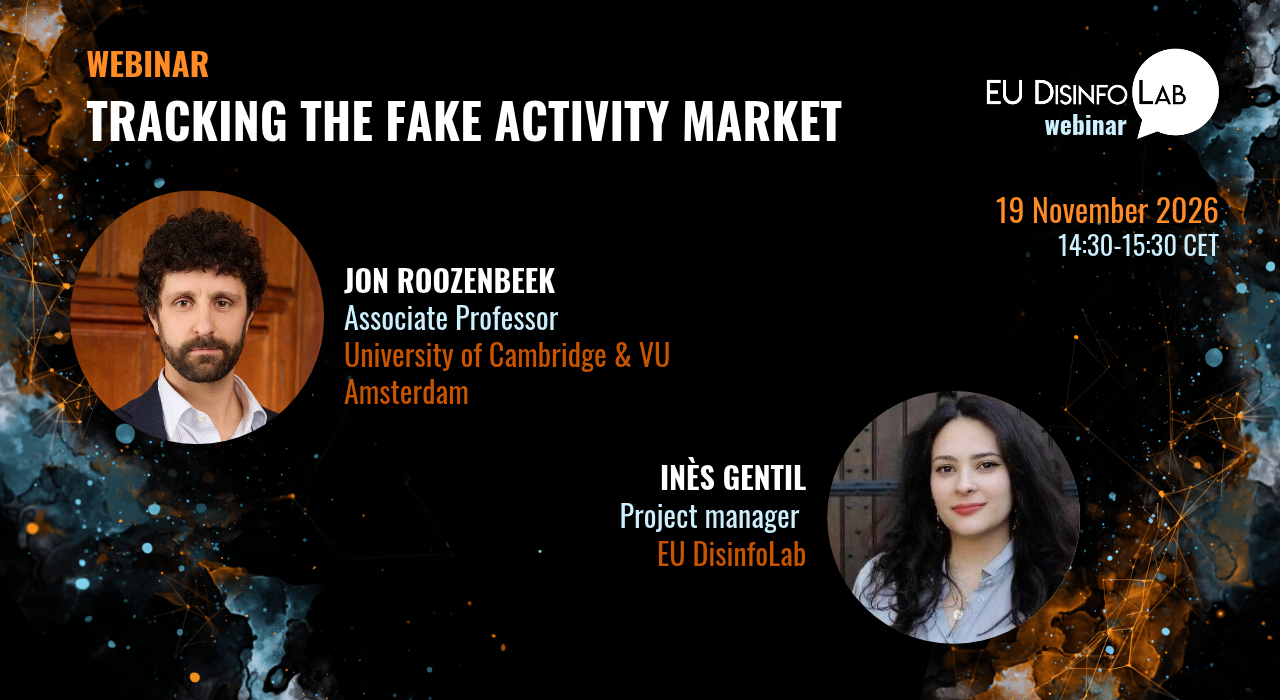
In this webinar, Jon Roozenbeek from the University of Cambridge argues that while we can’t eliminate inauthentic activity altogether, we can try to make it expensive. He’ll also present the Cambridge Online Trust and Safety Index (COTSI; cotsi.org), a free online tool which tracks the daily price of fake accounts and SMS verifications for more than 200 countries and 500 online platforms.
This webinar will explore:
– How the manipulation market works
– What predicts the price and availability of fake activity
– Solutions to disincentive its production
Registration for our webinars happens through DisinfoHub. As we review all sign-ups manually, approval may take some time, so please register early to make sure you don’t miss the session.
Speaker: Jon Roozenbeek, University of Cambridge & VU Amsterdam
Jon is Director of the Influence and Technology Lab, which sits between the University of Cambridge’s Department of Psychology and the Department of Communication Science at VU Amsterdam. His research focuses on (mis)belief formation, intergroup conflict (particularly in Russia and Ukraine), polarisation, underground manipulation markets, and the use and misuse of modern communication technologies. He holds a PhD in Slavonic Studies (2020), also from the University of Cambridge, for which he studied propaganda and ideology-building in Russian-occupied Donbas (Ukraine). Jon has authored two recent books with Cambridge University Press: The Psychology of Misinformation (with Sander van der Linden) and Propaganda and Ideology in the Russian-Ukrainian War. In addition, he has written more than 70 peer-reviewed publications. His work has been awarded numerous distinctions, including the 2024 Rising Star Award (Association for Psychological Science) and the 2025 Jim Sidanius Early Career Award (International Society of Political Psychology), and he is among the ISI top 1% most-cited scientists worldwide.
Moderator: Inès Genil, Project Manager at EU DisinfoLab
Inès Gentil is a Project Manager at EU DisinfoLab, where she contributes to the implementation of EU-funded projects – including EDMO BELUX 2.0, ANTIGONE, DIGINEXUS, PERISCOPE and EDRN – alongside other projects and initiatives in the counter-disinformation space. She holds a double Master’s degree in Policies and Governance in Europe from King’s College London and LUISS University in Rome, with a specialisation in European external relations. Prior to joining EU DisinfoLab, she gained experience across a range of institutions and sectors, including a London-based consultancy specialising in EU and UK public affairs, the United Nations Democracy Fund, the French Ministry of the Armed Forces, and the U.S. Embassy in Paris – bringing a multidisciplinary background in European governance, defence, security, and public diplomacy.
The opinions expressed are those of the speakers/authors and do not necessarily reflect the position of EU DisinfoLab. This webinar does not represent an endorsement by EU DisinfoLab of any organisation.