

Can European software built on cheap Chinese AI models be trusted?
As open-source model families like Alibaba’s Qwen surge in global popularity, an increasing number of international developers are quietly integrating them into their tech stacks. However, this cost-effective accessibility may come with a significant hidden vulnerability: the systematic embedding of Chinese propaganda into core AI architectures.
Drawing directly from a breakthrough report for the Swedish Psychological Defence Agency, co-author Alex Colville examines the geopolitical strategy behind China’s ambitions, Xi Jinping’s doctrine of controlling foundational AI development as a means of shaping global technological standards and international information ecosystems, as well as its use for Foreign Information Manipulation and Interference (FIMI) purposes.
The session breaks down specific PRC tactics on how state-approved narratives are encoded into large language models (LLMs), dispelling common misconceptions about censorship and propaganda. It will also examine the practical steps that European policymakers, developers, and other stakeholders can take to mitigate FIMI-related risks associated with Chinese AI models and safeguard information integrity.
Watch the recording
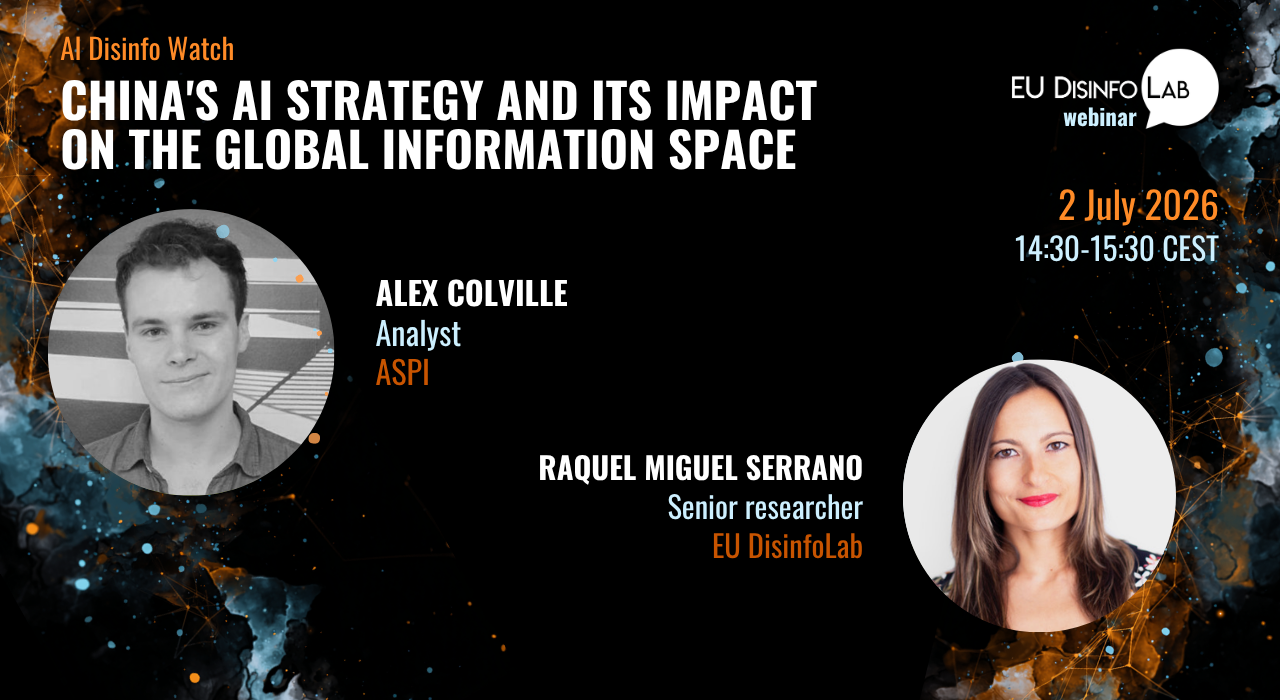
Speaker: Alex Colville, Analyst at ASPI.
Alex Colville is an Analyst at ASPI, an Australian-based think tank. He previously worked for the Taiwan-based research firm China Media Project, where he was the lead researcher for a report on the intersection of Chinese AI and propaganda for the Swedish government. He has written on Chinese affairs for The Economist, The Financial Times, and The Wire China. He has a background in coding from a scholarship with the Lede Program for Data Journalism at Columbia University. He worked in Beijing from 2019 to 2022.
Moderator: Raquel Miguel Serrano, Senior Researcher, EU DisinfoLab
Raquel Miguel Serrano is a senior researcher at EU DisinfoLab. She has a background in journalism and spent most of her professional career working for the German press agency DPA until 2019, when she shifted her focus to disinformation. Raquel earned a Master’s degree in Cyber Intelligence and joined EU DisinfoLab. She is the author of multiple articles, mainly focused on mis- and disinformation circulating in Spain and Germany, but also on more comprehensive topics such as the impact risk of online disinformation or pre-bunking as a tool to counter information disorders. Recently, she has been working in other areas, such as FIMI or the challenges posed by generative AI.
The opinions expressed are those of the speakers/authors and do not necessarily reflect the position of EU DisinfoLab. This webinar does not represent an endorsement by EU DisinfoLab of any organisation.