

The Commission’s decision to fine X under the DSA was not only built on regulatory investigation – it was also strongly supported by evidence produced by civil society organisations. Yet collecting, packaging, and submitting usable evidence remains difficult in practice: unclear expectations, inconsistent feedback loops, limited access to platform data, and significant operational risks for organisations doing the work.
In this webinar, Marc Faddoul from AI Forensics shared insights from their direct experience contributing to evidence production. The session covered how evidence was gathered and structured, lessons learned from engaging with the Commission, and risks that emerged when protections failed – including concerns following the publication of the full decision and its impact on civil society contributors
This is was a Community Insider session, reserved for regulators and civil society groups working on countering disinformation. No recording is available due to the closed nature of the discussion.
This webinar is part of our ‘Evidence & Enforcement’ series.
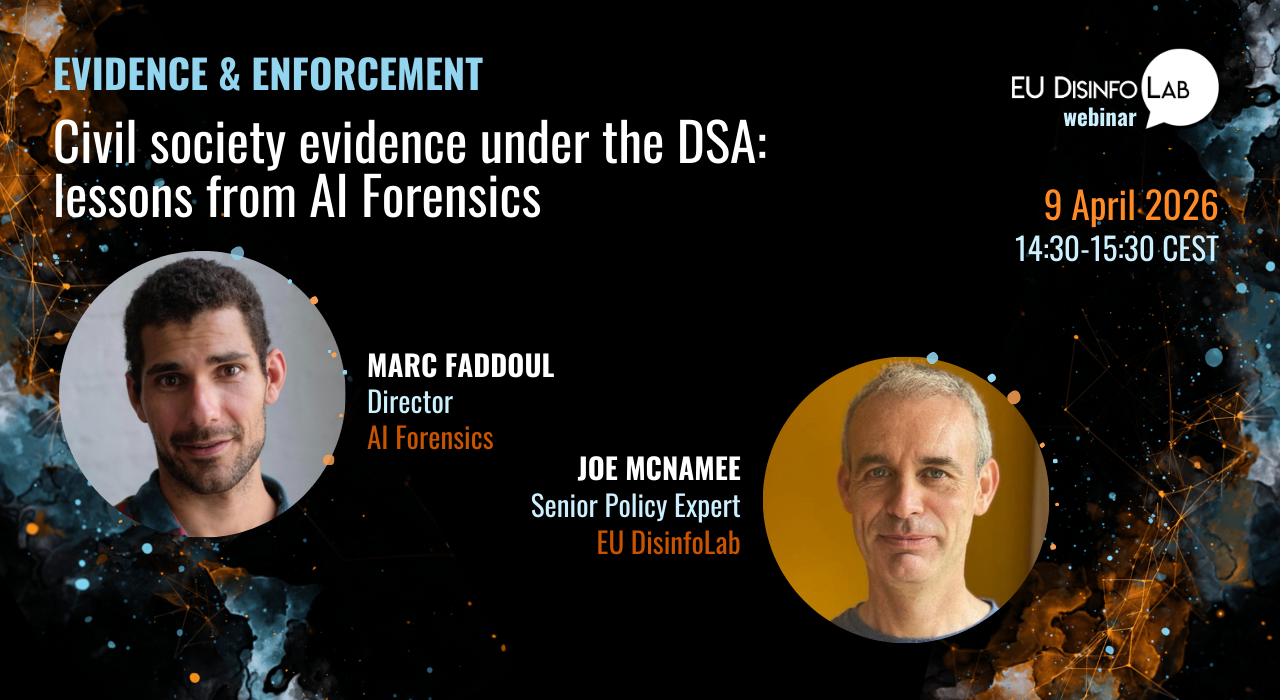
Speaker: Marc Faddoul, AI Forensics
Moderator: Joe McNamee, Senior Policy Expert, EU DisinfoLab
Joe McNamee has been working on topics related to internet regulation for over 20 years. Prior to his current role as Senior Policy Expert at EU DisinfoLab, he worked as policy adviser for a political group in the European Parliament. From 2009 to 2018, he led European Digital Rights, the association of digital civil rights organisations in Europe, working on major topics such as the adoption of the General Data Protection Regulation and the Copyright Directive. Prior to this, Joe worked for a political consultancy specialised in telecommunications and internet policy, where he led three research projects funded by the European Commission. During this time, he also worked on the EU’s E-Commerce (the predecessor to the DSA) and ePrivacy Directives. Joe holds master’s degrees in European Politics and in International Law.
The opinions expressed are those of the speakers/authors and do not necessarily reflect the position of EU DisinfoLab. This webinar does not represent an endorsement by EU DisinfoLab of any organisation.