

The combination of large language models and AI agents could add a new layer of risk to the threats AI already poses to the information environment, potentially reaching levels we are only beginning to imagine.
Drawing on recent research on malicious AI swarms, this webinar opens a discussion on how AI-enabled disinformation may evolve and scale in sophistication and coordination: from persistent AI personas and AI-supported botnets to cyborg propaganda through verified human accounts, adaptive engagement testing, and campaigns designed to manufacture the appearance of public consensus.
But the session does not stop at mapping the risks. It also aims to open a timely debate on possible responses, and on the evidence, infrastructure, governance, and safeguards needed, with the AI Influence Observatory as a flagship proposal to make these emerging risks more visible, comparable, and democratically accountable.
The discussion explores how researchers, civil society, journalists, platforms, and public institutions can jointly study and respond to this emerging risk, including through an operational taxonomy, a curated repository of cases, simulation environments to study swarm behaviour, behavioural and coordination-based detection signals, and prototype “AI Shields”.
Rewatch here!
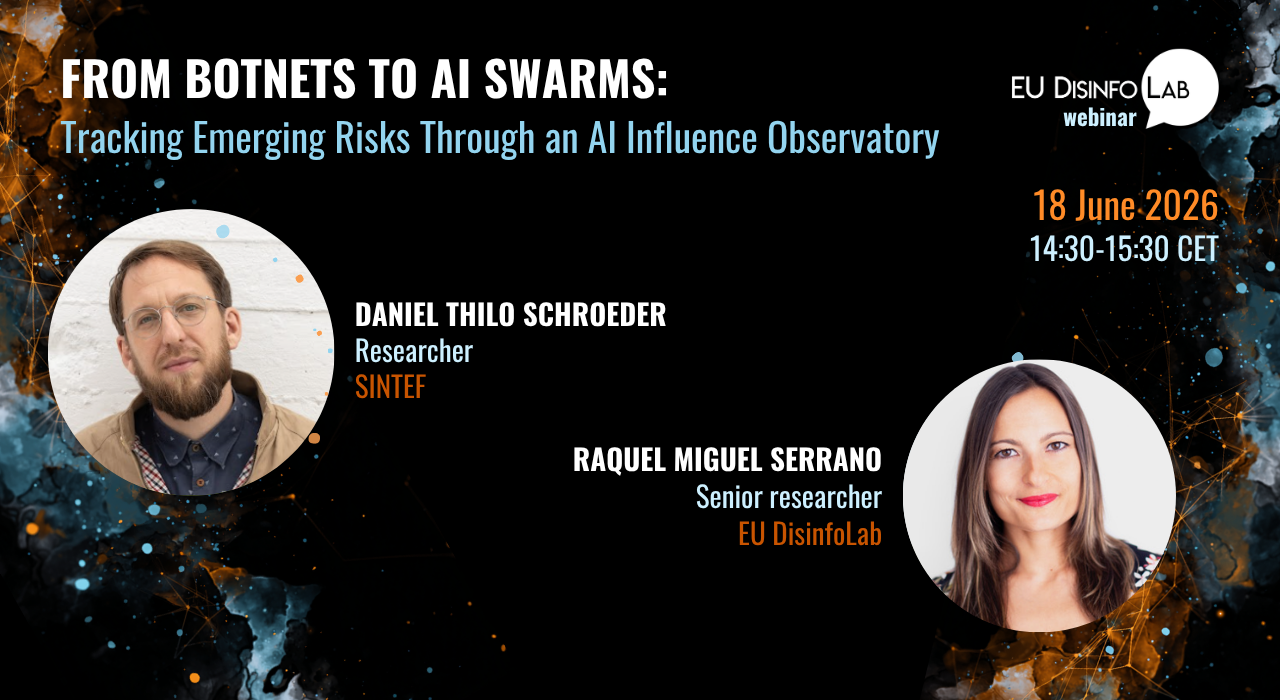
Speaker: Daniel Thilo Schroeder, Researcher at SINTEF
Dr. Daniel Thilo Schroeder is a researcher at SINTEF Digital working on AI, democracy, and information integrity. His current work focuses on malicious AI swarms: coordinated systems of agentic AI that can manipulate public discourse through persistent personas, adaptive messaging, and synthetic consensus. His recent papers examine how malicious AI swarms can threaten democratic resilience and propose responses such as AI Shields and a distributed AI Influence Observatory.
Moderator: Raquel Miguel Serrano, Senior Researcher, EU DisinfoLab
Raquel Miguel Serrano is a senior researcher at EU DisinfoLab. She has a background in journalism and spent most of her professional career working for the German press agency DPA until 2019, when she shifted her focus to disinformation. Raquel earned a Master’s degree in Cyber Intelligence and joined EU DisinfoLab. She is the author of multiple articles, mainly focused on mis- and disinformation circulating in Spain and Germany, but also on more comprehensive topics such as the impact risk of online disinformation or pre-bunking as a tool to counter information disorders. Recently, she has been working in other areas, such as FIMI or the challenges posed by generative AI.
The opinions expressed are those of the speakers/authors and do not necessarily reflect the position of EU DisinfoLab. This webinar does not represent an endorsement by EU DisinfoLab of any organisation.