

Open-source verification can catch the Kremlin’s official narrative contradicting the footage on the ground. That’s exactly what’s happening in Belgorod, where Russia’s own glide bombs, built to hit Ukraine, keep falling short onto Russian soil.
BBC Monitoring’s Chief Analyst Vitaly Shevchenko shows how using two recent cases: security camera footage catching one such bomb falling, and a man calling it a Russian glide bomb while the regional governor’s own account pointed instead to a Ukrainian drone.
You’ll learn:
– How to verify official claims against real-time footage using OSINT techniques.
– What Russian state and pro-Kremlin media reveal about the true state of the war effort – The social and cultural context driving disinformation narratives in Russia and Ukraine
– Why sustained media monitoring is essential in an age of information overload.
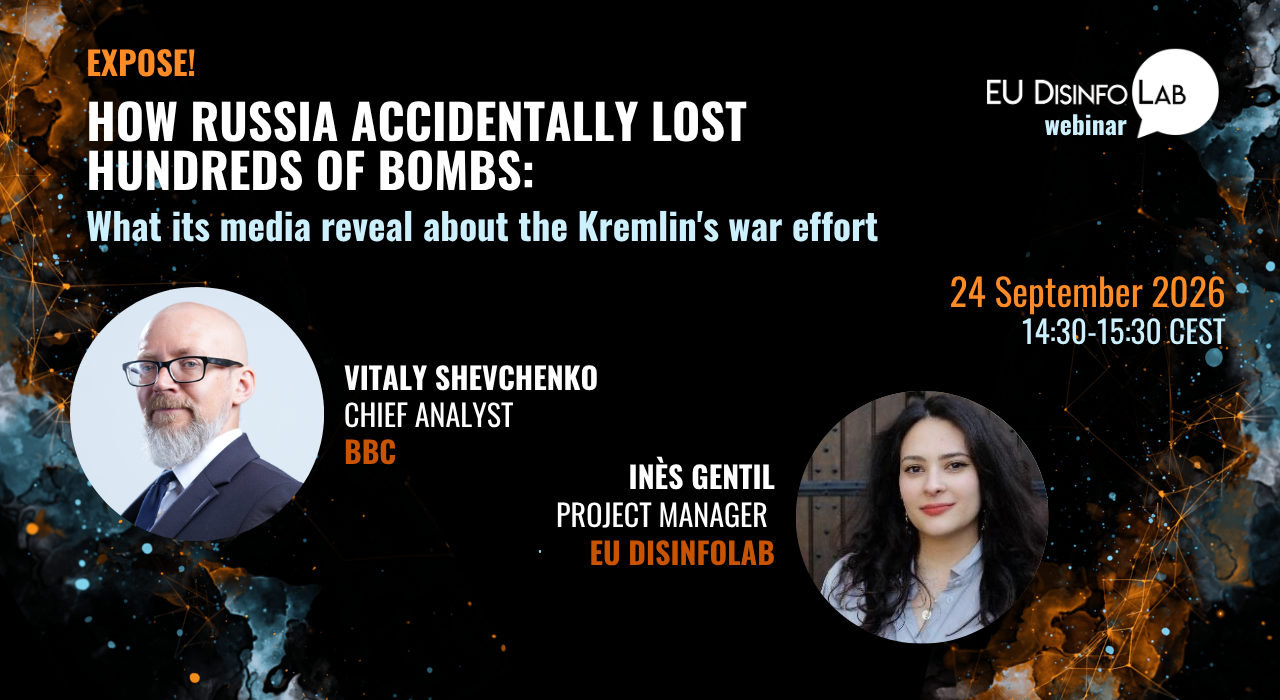
Speaker: Vitaly Shevchenko, Chief Analyst at BBC Monitoring
Vitaly has spent almost 25 years working for the BBC, primarily focusing on Russia. Originally from Ukraine, he has also been heavily involved in covering the war between the two countries. He can discuss political and media developments, verification and disinformation techniques, as well as the underlying social and cultural context of the current developments in Russia and Ukraine.
Moderator: Inès Genil, Project Manager at EU DisinfoLab
Inès Gentil is a Project Manager at EU DisinfoLab, where she contributes to the implementation of EU-funded projects – including EDMO BELUX 2.0, ANTIGONE, DIGINEXUS, PERISCOPE and EDRN – alongside other projects and initiatives in the counter-disinformation space. She holds a double Master’s degree in Policies and Governance in Europe from King’s College London and LUISS University in Rome, with a specialisation in European external relations. Prior to joining EU DisinfoLab, she gained experience across a range of institutions and sectors, including a London-based consultancy specialising in EU and UK public affairs, the United Nations Democracy Fund, the French Ministry of the Armed Forces, and the U.S. Embassy in Paris – bringing a multidisciplinary background in European governance, defence, security, and public diplomacy.
The opinions expressed are those of the speakers/authors and do not necessarily reflect the position of EU DisinfoLab. This webinar does not represent an endorsement by EU DisinfoLab of any organisation.